Everything You Wanted To Know About Electric Vehicles… but were afraid to ask

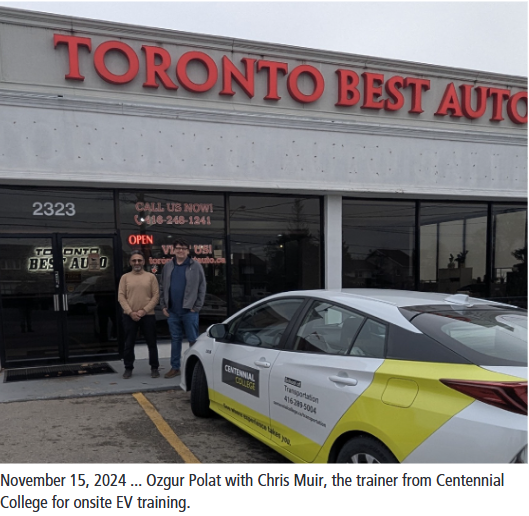
Ozgur Polat (Toronto Best Auto) – “This training would be beneficial, not only for mechanics, but also for sales staff. Customers trust salespeople who really know their stuff.”

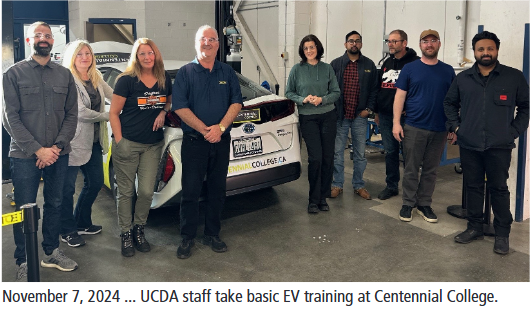
The UCDA is partnering with Centennial College to deliver Electric and Hybrid (EV) vehicle training to your staff and offering 50% off the cost of the basic programs!

This will cover not just your OEM’s product, but the wider range of EV and Hybrid offerings to address the aftermarket potential of this market.

Centennial College is the largest school of Transportation in Canada. Since 1966 they have trained thousands of technicians across a multitude of transportation trades.

Whether it is basic or intermediate knowledge your team seeks, you can familiarize your sales staff with the EV product at its most basic level, or take a higher-level dive in for your existing 310S service technicians. Centennial and the UCDA are working together to deliver it to you.

Offered to class sizes no larger than 12, Centennial will come to you, take over a bay for a few hours, and teach the program offerings described below:

Basic

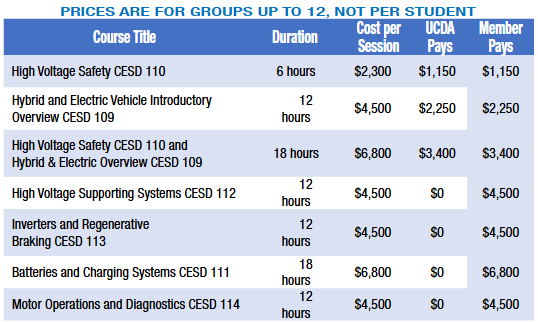
High Voltage Safety CESD 110 (6 hours)

A perfect primer for sales staff and techs who may know very little about this unique form of motor vehicle, this course requires no technical knowledge, takes 6 hours, and costs $2300.

The UCDA will pay 50% of that cost!

Centennial College will issue you a Certificate at the end of this 6 hour course.

Hybrid and Electric Vehicle Introductory Overview CESD 109 (12 hours) Your existing 310S service techs will benefit from this because it offers a more detailed technical overview taking a total time of 12 hours at a cost of $4500.

The UCDA will also offer 50% cost sharing of this option as well!

Centennial College will issue a Certificate at the end of this 12 hour course.

CESD 110 plus Hybrid and Electric Vehicle Introductory Overview CESD 109 (18 hours) Your existing 310S service techs will benefit from this because it adds on to the basic introduction with some more detailed technical overview taking a total time of 18 hours over 3 days at a cost of $6800.

The UCDA will also offer 50% cost sharing of this option as well!

Centennial College will issue a Certificate at the end of this 18 hour course.

The best part? Centennial will come to you, whether you are in Thunder Bay, Windsor, Ottawa or the GTA! Some distance courses will involve an additional hotel and travel charge.

Intermediate

As you can see below, for those dealerships that really want a full training approach, there are additional options you can consider for your Techs including CESD 112-114.

After taking these courses, Centennial will offer a College Certificate of Completion.

Sign up your dealership today!
PRICES ARE FOR GROUPS UP TO 12, NOT PER STUDENT


UCDA Childhood Cancer Charitable Giving

Just in time for Christmas!!!

December 3, 2024 Is “Giving Tuesday”

The Board of Directors of the UCDA, on behalf of all UCDA members, have once again decided to make a series of donations to the worthy charities listed below. We do this to honour “Giving Tuesday”, and also to support the efforts of the great men and women who have made it their goal to support children and their families in their journey through the challenges presented by childhood cancer.

What is “Giving Tuesday”?

Giving Tuesday was created in 2012 to inspire people to perform acts of kindness and support their communities. Since then, Giving Tuesday has grown globally, with active movements in more than 80 countries, engaging millions of people. The first Giving Tuesday movement arrived in Canada in 2013, to specifically drive fund-raising efforts for local, home-grown organizations.

December 3, 2024, is the day that Canadians donate to their favourite non-profit organizations and charities. As we do throughout the year, the Board of the UCDA decided, once again, to support, on behalf of all UCDA Members, a variety of grassroot charities engaged in the battle against cancer in children.

Help a Child Smile

… in Hamilton, is one such charity, with the funds they receive, they are able to raise a very sick child’s spirits with special “dream” trips, as well as provide supports for families in the form of gas cards, parking vouchers and various outings. Like to donate? Do so here: https://canadahelps.org/en/dn/124020

Childcan

.. in London, similarly supports children and their families through their journey and battle with cancer. Like to donate? Do so here: https://childcan.com/ucda

Candlelighters Simcoe

… serving Simcoe County (Barrie, Collingwood, Orillia), Bracebridge, Gravenhurst, Huntsville, Bradford, and as far east as Keswick, Candlelighters assist families who have a child with a diagnosis of cancer.

Northern Ontario Families of Children with Cancer

… is a Canadian registered not-for-profit charity which relies solely on community fundraising and private donations in order to assist approximately 200 families annually in Northern Ontario, with the costs of having to travel for pediatric cancer treatment across Ontario.

Kids Kicking Cancer

… in Windsor, provides therapeutic martial arts classes and therapeutic visits in the hospital for children and youth, aged 3 to 18, in pain (physical, emotional and/or intellectual). Like to donate? Do so here: https://www.canadahelps.org/en/dn/121793

Ontario Parents Advocating for Children with Cancer

… (OPACC) in Barrie, ON. use our support to help childhood cancer families pay for the costs of parking at any pediatric oncologytreatment centres in Ontario. As an example, at the Hospital for Sick Kids in Toronto (where most families go), the cost of a 5-use parent H-Pass is $50. Like to donate? Do so here: https://opacc.org/donate

UCDA Members are making a difference with every dollar they donate to these great charities and others we have supported this year. All of these charities are engaged in the battle against cancer and the toll it takes on the body and spirit of children and their families.

UCDA MEMBERS ARE PROUD SUPPORTERS OF THE FIGHT AGAINST CHILDHOOD CANCER

Happy 40th Birthday UCDA

My oh my, how you have grown! You were just a baby on November 15, 1984, when you were born, but now you are in your prime at 40!

We hope you all enjoyed your 40th Anniversary gift packages from the UCDA!

When the UCDA’s first Executive Director, Bob Beattie, and 7 other used car dealers got together at a restaurant in 1984 to discuss how they could unite the used car industry in the face of proposed changes to rules governing used vehicle sales, they could not have foreseen what their creation would grow to become.

The UCDA became the first non-profit organization in Canada established to represent the needs of dealers who sell used vehicles.

The early years focused on lobbying efforts with government, aimed at raising awareness of the concerns of an industry that was often ignored, or worse, sneered upon. It was for good reason that the Association’s mission statement was, and remains, “To enhance the image of the industry”.

The UCDA grew rapidly. The single most important factor in our early growth was the introduction of phone-in lien searches for Members. It’s hard now to imagine what an innovative break-through this was for dealers, offering them an option other than what was a very cumbersome government phone service at the time.

The early lien search success surpassed everyone’s wildest dreams. The UCDA search services expanded over the years to include other search options to help dealers do their due diligence in an increasingly complex commercial environment. Delivery moved away from phone to fax and finally to online. Some of our Members still use phone and fax, but online searches are vastly more popular now.

This growth led to the UCDA service becoming the largest online vehicle information search portal in Canada: www.ucdasearches.com

Member services have always been a priority for the UCDA. The better, and more relevant, the services … the more likely a Member will renew year after year. Retaining Members was a favourite mantra of Bob Beattie, no less important than gaining new ones. In fact, the presence of so many long-term Members is a testament to the wisdom of Bob’s vision.

In the 1990s, used car dealers needed an insurance program and today, Baird MacGregor Insurance Brokers remains the UCDA’s only insurance brokerage. More than 1,600 Members enjoy rate stability and a unique annual claims free rebate.

A few years later, we added our NAPA parts program, which each year provides more than a million dollars in rebates to Members. Throw in an affordable health plan and a credit card merchant discount program and the value of a $230 annual Membership is pretty clear.

The auto industry has changed a lot in the past 40 years.

We have seen industry self-management come … and go … with OMVIC, and completely overhauled regulation with the Motor Vehicle Dealers Act, 2002.The industry has seen mandatory disclosure requirements, mandatory education requirements, and some of the strictest advertising regulations in Canada.

Through it all, the UCDA has played a significant role in the development of Ontario’s auto industry. We’ll be here as the industry undergoes even more significant changes in today’s digital world.

With this in mind, the UCDA is increasing its presence on social media and beginning to address the needs of the EV market, soon to become a bigger factor in the aftermarket than it is at present.

Speaking of social media, if you feel like giving the UCDA a “Birthday Gift”, please consider giving us a review on Google https://tinyurl.com/uvjfs5sa

We would not be where we are today without the strong support of Members … and now there are 5,000 of you!

Congratulations and “Thank You” from all of us at the UCDA, our staff and Board of Directors, to all of our wonderful Members and …

HAPPY 40TH BIRTHDAY UCDA!!!

Crime Stoppers and the UCDA

The Ontario Association of Crime Stoppers is an association of 37 local Crime Stoppers programs across the province of Ontario.

Each local program is an independent not-for-profit corporation with charitable status that is community based and independent of the police or any law enforcement agency. Their board of directors is made up of volunteers who give their time and expertise to promote crime reduction and safety within their communities.

Crime Stoppers provides a venue for concerned citizens to anonymously provide information to law enforcement agencies through Crime Stoppers’ 1-800-222-TIPS line or through a web-based application. The caller’s name and address are not displayed to the call takers nor are callers asked to identify themselves.

The anonymity of tipsters is guaranteed by Supreme Court of Canada rulings that ensures both the tipster’s identity and the information contained within the tip cannot be released or subpoenaed to court. If the tip leads to an arrest or the recovery of drugs or stolen property, the tipster may be eligible for a reward of up to $2,000.00.

Each local board relies on sponsorship, donations and fundraising to garner the funds to pay rewards and operate the program. We are continuously looking for both financial support and volunteers eager to make a different in their communities.

The Ontario Association of Crime Stoppers is grateful for the support we receive through partnerships such as with the United Car Dealers Association. These partnerships allow us to continue to the important work we do toward the safety of our communities.


Allan T. Burns,

President,

Ontario Association of Crime Stoppers

ocs

Auto theft has become a prominent issue, frequently highlighted in news reports. The thefts are occurring at an alarming rate, affecting not only private individuals, but also dealerships. Ontario is at the center of this trend.

In a strategic move, the UCDA has joined forces with Crime Stoppers to tackle the issue of vehicle theft at Ontario automotive dealerships. Our joint efforts will focus on education, promotional activities, and law enforcement, utilizing the famous anonymous tip service provided by Crime Stoppers.

The UCDA has sponsored rewards up to $300, for tips that directly lead to the successful recovery of vehicles stolen from dealerships in Ontario.

Individuals that have information can share anonymously toll free at 1-800-222-8477 or online at https://tinyurl.com/mppd2b2t

Fraud

In late September, an article on CP24 related the findings in an Equifax report on identity fraud and fake credit applications. It likely comes as no surprise to our Members that auto fraud has risen by 54% year over year. These kinds of frauds tend to rise in lock step with challenging economic times, and we are certainly in the midst of that.

There is some good advice for dealers in this article, that echoes what we have said for years about the steps dealers should take.

Ritika Dubey, The Canadian Press Published Tuesday, September 24, 2024

Driven by fake credit applications and identity theft, automotive fraud has surged 54 per cent from a year ago, a report from Equifax Canada has found.

“That kind of increase really indicates there’s a specific targeted attack to that sector,” said Carl Davies, head of fraud and identity at Equifax Canada, in an interview.

The biggest jump in auto fraud rates was in Ontario, where they doubled since last year, said the report released Tuesday.

Rising vehicle prices in recent years have made the industry a target for fraud, Davies said, while in his opinion, recourse against criminals remains limited.

“When you combine those two, I think that’s driven a lot of the fraud activity into the auto sector this time around,” he said.

But not all fraudsters are organized criminal groups, Davies said.

The most common type of fraud was first-party fraud, where people knowingly provide false information about their finances, such as lying about how much money they make.

About 60 per cent of fraud within the auto sector was related to consumers misrepresenting their financial situation, Davies said. While that’s roughly comparable with last year, it remains a concern for lenders.

He said the high cost of living, which has pressured many Canadians’ household budgets, could also be underpinning rising fraud rates.

“If they absolutely need the car … I think they will do whatever’s necessary,” Davies said.

First-party fraud was higher among younger Canadians because they think white lies won’t hurt them, he said, but providing false information can lead to serious penalties in the long term such as loan denials, damaged credit and legal ramifications.

Davies thinks first-party fraud will continue to be a trend as people struggle with the economic slump and high unemployment.

The proportion of identity theft in credit applications continued to grow, the report said, with 48.3 per cent of all fraudulent applications flagged as identity theft in the second quarter, up from 42.9 per cent during the same time last year.

While lenders bear the brunt of fraud, Davies said it affects everyone in the long run.

“The lender, unfortunately, has to recover that cost from somewhere and ultimately what that translates to is higher costs for everybody,” he said.

Equifax called for caution and vigilance among businesses and consumers.

Businesses should use identity theft protection tools to detect fraud early, the report suggested. This includes verifying identities, cross- checking financial documents and staying informed about regional fraud trends.

“If something comes up and it sounds too good to be true, then trust your instincts,” Davies said.

Cyber-Crime Costing Businesses Plenty

CTV News reported in late October that some businesses paid a ransom of more than $500,000 after a cyberattack last year, new Statistics Canada data revealed.

The report surveyed more than 12,000 businesses to investigate the impacts of cybersecurity incidents on enterprises across Canada, including how many are paying attackers after getting hit by ransomware.

In 2023, an estimated 2% of Canadian businesses reported being hit by ransomware, which is a type of cybersecurity attack that encrypts files and comes with a payment demand to make those files available again.

Though most affected businesses didn’t make a payment, 12% did give money to attackers, the report says.

Most payments were relatively small — 84% of ransom payments were under $10,000. The report estimates that 4% of businesses who paid after a ransomware attack handed over more than $500,000.

Only 13% of businesses who dealt with a cyberattack ended up reporting the attack to police, the survey found, though that number is up from 10% in 2021. More than half of incidents that did get reported were related to stealing money or demanding ransom payments.

Canadian businesses spent $1.2 billion recovering from cyber- security incidents last year, double what was paid a couple of years earlier.

That’s also a sixfold increase from 2019, when businesses dished out $200 million according to the report.

The cost of cybersecurity continues to rise, with businesses also spending $11 billion on prevention and detection in 2023, compared to $9.7 billion in 2021. Most of that was on salary related to prevention and detection of cyberattacks.

The sample size for this survey was 12,462 enterprises and is representative of the 208,537 businesses with Canadian operations and 10 or more employees, across most economic sectors, except for public administration. See more here https://tinyurl.com/yc8cdv7h

We’re Not Living in the Wild West: Repairers Must Follow the Law

The Repair and Storage Liens Act (“RSLA”), allows repairers to claim a lien against a vehicle for unpaid repair and storage work. This is a powerful self-help remedy that repairers can use to get paid, but failure to follow the rules can mean serious consequences. A loan company found this out the hard way in a recent case coming out of the Ontario Small Claims Court.

The case involved a rental company, which had rented out a vehicle to a customer. The customer’s daughter somehow got hold of the vehicle during this time. Mysteriously, around the same time, the vehicle’s registration was transferred out of the name of the rental company!

The daughter had new tires and rims installed on the vehicle by a mechanic shop. The daughter worked with a loan company to finance the installation. The loan company entered into a loan agreement with the daughter and paid the mechanic shop directly. The mechanic shop released the vehicle to the daughter and the loan company registered a RSLA lien on the vehicle.

The rental company begun to look for the vehicle and finally recovered it. The police charged the daughter with theft. The loan company then tried to collect on their RSLA lien. The rental company contested the lien in court.

The court found that the loan company did not follow the proper procedure under the RSLA and ruled the lien was invalid. While the loan company had registered a non-possessory RSLA lien, the proper paperwork was missing to support it. The court said the mechanic shop should have registered the non-possessory lien and then assigned the lien to the loan company.

In fact, the court observed, in this case the mechanic shop did not have a legitimate non-possessory lien in the first place. While the daughter had signed an agreement with the loan company, the mechanic shop did not obtain a “signed acknowledgment of indebtness” from the daughter, which is required by the RSLA to support a valid lien.

The fact that the loan company had directly paid the mechanic shop for the work was also an issue. While the mechanic shop had prepared an invoice for the work, the evidence showed that invoice had been paid 4 days before the mechanic shop tried to claim a lien interest in the vehicle. In other words, there was no outstanding debt for the mechanic to claim a lien interest on and, in turn, no lien interest to assign.

This case serves as a reminder that process and paperwork matters. Repairers should also take caution before agreeing to perform work on vehicles when they are not certain that they are dealing with the owner of the vehicle or someone who has the vehicle with the owner’s permission.

Members interested in reading the full court decision can do so by following this link: https://www.canlii.org/en/on/onscsm/ doc/2024/2024canlii103672/2024canlii103672.html

New Changes Affecting the Towing and Storage Industry Come Into Effect

This is a follow up / reminder of an issue we reported on before in Front Line. We have been getting a lot of calls about it so it bears repeating, as it affects garages seeking to charge storage under the Repair and Storage Liens Act as well.

A new regulation came into effect under the Towing and Storage Safety and Enforcement Act (TSSE) on January 1, 2024. The TSSE now requires that tow truck and vehicle storage operators become certified with the Ontario Government and follow a Code of Ethics in order to provide towing or storage services.

Tow truck and vehicle storage operators must also provide customers with additional documentation, information, as well as choice regarding how services are delivered and can only charge customers reasonable rates based on a “maximum fee schedule” which must be filed with the Ontario Ministry of Transportation (MTO).

Be Sure to File a “Maximum Rate Schedule” and Be Ready to Justify Your Prices

Tow truck and vehicle storage operators will be required to submit a schedule setting out the maximum rates that they charge their customers to MTO. This rate schedule should also be made publicly available on the company’s website (if the company has one).

While the TSSE does not establish a set rate which operators can charge, it requires these rates to be a “reasonable amount” and sets out a list of criteria for determining reasonableness which includes an assessment of the rates charged by other operators in the area, previous amounts charged by the operator or other operators in the area, as well as a comparison of the charged rates to those allowable under the Restricted Towing Zones pilot project and other similar programs. Reasonableness will be determined by assessing the time, labour, skill, equipment in light of the importance in keeping the service accessible to members of the public with limited means.

That said, the fee rules under the TSSE will not apply to those acting under an agreement between operators and the Crown. This includes the OPP Tow Program (which already has a pre-authorized fee schedule), MTO’s Provincial Highway Incident Management Limited Financial Program, or the Heavy Tow Program.

Dealers Who Want to Charge Storage Must Register

Dealers will not be considered to be providing vehicle storage services under the TSSE if they do not charge for the service.

The TSSE makes it clear that an organization will not be considered to be a vehicle storage operator to the extent they only store vehicles in order to repair them and do so at no additional cost to the vehicle owner: “vehicle storage yard facility” does not include a lot used by a vehicle repair business, if the storage is ancillary to repairing the motor vehicle and provided at no cost to the vehicle owner or its operator. (“installation d’entreposage de véhicules”)

There are also certain exemptions from the TSSE for vehicle storage services provided in connection with the purchase or lease of a motor vehicle or where this service is provided as part of a membership in an automobile club or association: (3) Sections 20 and 27 of the Act do not apply in respect of the provision of towing services or vehicle storage services where the services are either free of charge or prepaid because the service is provided as part of a membership in an auto- mobile club association or in connection with the purchase or lease of a motor vehicle.

That said, dealers who charge or intend to charge customers for storage will need to be certified in order to do so. Such dealers may apply here: https://tinyurl.com/32c66ern

Members can access the TSSE and its regulations at the following link: https://tinyurl.com/3mec8mmc

Ontario Attacks Re-Vining

Ontario dealers have long known about the nefarious practice of re-vining or “cloning” stolen cars to try to trick dealers and consumers into buying them. Once a fake title trail is created, it can be easier to pass the vehicle off to innocent buyers.

Now it seems Ontario lawmakers are finally catching up to the bad guys!

News outlets report the Ontario government plans to crack down on Vehicle Identification Number (VIN) fraud.

The Ford government is set to introduce stiff penalties for thieves who rip off legitimate VINs and apply them to stolen vehicles.

https://tinyurl.com/yjyv25k8

While multiple levels of government have thrown hundreds of millions towards cracking down on the auto theft crime wave, politicians have also been warned about a second layer of crime targeting a vehicle’s unique 17-character identification number, known as a VIN.

The code, which includes information about a vehicle’s make, model, year and manufacturing location, is widely considered to be a fingerprint for cars. The VIN has increasingly become a target for thieves looking to legitimize a stolen vehicle.

The Insurance Bureau of Canada says the process of “reVINing” has been “particularly pronounced” in Ontario and has called on the Ford government to implement a suite of reforms.

During a 14-month period in 2023 and 2024, ServiceOntario investigated 615 cases of fraudulent vehicle registration, the govern- ment documents stated, requiring new tools for police officers to target the growing issue.

The Ford government plans to introduce legislation to create a new Highway Traffic Act (HTA) offence for knowingly providing the Ministry of Transportation with a false VIN, with possible fines and jail time for convicted fraudsters.

The proposed legislation would create a new provincial offence under the HTA for knowingly providing a false VIN when applying for a vehicle permit. Penalties would be up to $100,000 for convictions, the possibility of up to six months in jail and up to one-year driver’s licence or vehicle permit suspension.