
Digital Safety Racing To TheFinish Line

With the most recent announcement shared with UCDA Members by way of our Dealer Alert on Sept. 3rd, the finish line for the full transition from the old way of doing safety inspections to the new digital safety across Ontario is fast approaching.

Enrolment into DriveON opened on September 3, 2024, for current MVIS facilities that only conduct light-duty/passenger vehicle inspections and they can now apply through the DriveON portal at www.driveonportal.com.

To ensure MVIS facilities receive their DriveON equipment prior to the ending of the MVIS program on December 31, 2024, it is strongly recommended they complete the enrolment process and purchase equipment prior to November 1, 2024.

To help support the industry, the ministry will be providing one complimentary inspection tablet to all currently licensed MVIS facilities whose applications have been approved to DriveON during the purchase of the initial equipment package.

MVIS facilities that only conduct light-duty/passenger vehicle inspections will be eligible to receive one complimentary inspection tablet if onboarded to DriveON before December 31, 2024.

If MVIS facilities don’t apply to DriveON by December 31, 2024, they will no longer be able to conduct light-duty/passenger vehicle inspections under the MVIS program. These facilities will have to wait until the next phase of onboarding occurring after December 31, 2024, to apply and will not be eligible to receive a complimentary inspection tablet.

  • The last day of processing orders for safety standards certificates is October 31, 2024. Stations can order a maximum of 10 books per order. Towards the end of the MVIS program, the amount of safety books allowed to be ordered will decrease.

If you have any questions about the new DriveON program, please contact the Vehicle Inspection Centre Assistance Line toll free at 1-833-420-2110 or by email at VIC@driveonportal.com.

To qualify for refunds:

  • unused forms of annual inspection and semi-annual inspection certificates and stickers must be returned by October 31, 2024
  • Heavy-duty stations must also return unused safety standards certificates by October 31, 2024.

Refunds will not be provided if unused annual inspection and semi-annual inspection forms and stickers are returned beyond these dates.

Further questions or concerns about refunds may be directed to the MVIS program via telephone at 1-800-387-7736, via Fax at 905-704-2574, or via email at MVIS.CIVA@ontario.ca
Transaction Fee On Out-Of-Province Sales

Recently the UCDA sent a Dealer Alert to let dealers know that, since 2022, the OMVIC portal for online dealer renewals was not as clear on Export sales as it could have been.

The problem was the question did not make it clear that the transaction fee was only for sales to out-of-province non-dealers. Dealers who feel they may have over-paid as a result, can email registration@omvic.on.ca to ask for another look.

See Dealer Alert here https://tinyurl.com/2s3wdmp9

To make your life and OMVIC’s easier, keep in mind, when selling to a dealer outside of Ontario, to use a wholesale bill of sale and record the dealer number or registry identifier, to show whether or not the buying dealer is from a Canadian, U.S., or other jurisdiction.

This will help immensely should you ever be asked to provide supporting documents to establish the sale was to a “real” dealer.

Peel Police Are ‘Best In Class’

The Peel Regional Police continue to impress, with their laser focus on fighting auto theft and fraud. Of course, Peel is at the center of the epidemic in that regard, and the Peel Police have responded admirably.

Their latest News Release only serves to underline how serious they are taking this issue:

October 10, 2024

Arrest Made in Defrauding the Public

Region of Peel – Investigators from the Peel Regional Police Fraud Bureau have arrested and charged an individual in relation to an alleged Automobile Sales Fraud that took place across the Greater Toronto Area (GTA) between the spring and summer months of 2023.

The suspect operated a fake business called “Aponic Leasing”, advertising luxury vehicles for sale on various social media platforms.

In one instance, the suspect met a victim at an unaffiliated car dealership and pretended to work there in order to defraud the victim.

The suspect would collect deposits from the victims for the sale of the luxury vehicles but never deliver the vehicles or return the money to the victims. To date, numerous victims have been defrauded in excess of $76,000. 

On Monday, October 1, 2024, Sadaf Farooq, a 30-year-old Brampton resident, was arrested and charged with Defrauding the Public and Possessing Property Obtained by Crime.  

He will appear at the Ontario Court of Justice in Brampton at a later date.

Export Check

A Tool to Protect Against Fake Buyers
EXPORT CHECK is available to help power dealers through their misgivings.

  • Is the vehicle a stolen car with a cloned (previously exported) VIN?
  • Is the buyer truly buying a vehicle for their personal use, or instead, planning to flip it or export it?

In other words, is the vehicle or the buyer legit or fake?

EXPORT CHECK powered by VINShield.ca

Dealers can use EXPORT CHECK to perform due diligence:

  • Search VINs from your Garage Register to see where vehicles you sold ended up
  • Run a RIN on suspicious buyers to check prior VIN’s for evidence of export
  • Help prevent auto theft, stolen clones often use exported VINs, check before you buy

A resulting report will be displayed showing the export status, country of import, and date of export.

Offered for $13.95 on the UCDA Search Portal under the heading EXPORT CHECK.

Nominees

Nominees, strawmen, agent, fake buyer. Call them what you will, the UCDA has never thought sending an individual to a dealer to buy a car that they pretend is for their personal use, but is actually destined for export, was ever anything but fraud.

These vehicles are intended to be flipped for export by some company lurking in the shadows who pays a fee to the nominee and then sells that same car for much more money overseas in places like the Middle East, China, Africa or Europe.

The lucrative nature of the trade might explain why some vigorously defend the practice and are quite self-righteous about it in the bargain. Many of these companies are ghosts in the transaction, never actually registering the unit in their name here in Ontario, so it appears the consumer was the last “owner”.

As we have written many times prior in Front Line, and elsewhere, we view this practice as unethical and illegal. Not just because it thwarts the legitimate business interests of vehicle manufacturers, but it also hurts the selling dealers (who face consequences from those same manufacturers) and the pawns used as nominees who have faced lawsuits by the selling dealer (for illegal export among other causes) and prosecution by regulators like OMVIC.

Examples of all this abound, and have for years, yet the “exporter” makes off scot-free in the wake of the chaos.

Just to be clear, we do not oppose exporters buying vehicles for export from other dealers. As long as they are upfront about it, use registered salespeople to act on the transaction and put the vehicle in their dealership name, like any other dealer would. As long the selling dealer enters willingly into the transaction with their eyes wide open. That is all we have ever expected to see … transparency, fairness, ethics, legality and professionalism.

Meanwhile, the good news is the worst of the practices outlined above may be coming to an end.

Here is OMVIC’s full message to all would-be nominees and exporters who are considering this practice as part of their business plan going forward:

https://tinyurl.com/yckhhrfw

Highlights are, export dealers must enter into a proper written contract to buy vehicles, register the vehicle in the dealer name prior to export and use properly OMVIC-registered salespeople to buy vehicles.

Take Ownership Prior to Export

Generally, like all dealers, Exporters must ensure that they complete and retain all appropriate documentation when they purchase a vehicle for the purposes of facilitating a future trade when they sell the vehicle to a subsequent purchaser.

In particular, Exporters are required to take ownership of any vehicle prior to exporting it by: (1) entering into a contract to buy the vehicle in the name of the dealership; and (2) within six days after becoming the owner of the vehicle, the Exporter must apply to the Ministry of Transportation (“MTO”) for a new permit for the vehicle. The result of the latter process is the issuance of a new permit by the MTO in the name of the purchaser (i.e., the exporter’s business name).

Given that Exporters are only permitted to buy vehicles and subsequently sell them elsewhere, it is important that Exporters comply with the MVDA provision that they are under a mandatory obligation to take ownership of the vehicle before exporting it.  They cannot simply broker a sale between an Ontario resident that owns a vehicle and a purchaser outside of Ontario that wishes to purchase it.  

Employees And Agents

Exporters are subject to the general statutory obligation that dealers, regardless of class of registration, must not retain the services of an unregistered salesperson. This includes the prohibition from retaining the services of unregistered individuals to facilitate the purchase of vehicles from another dealer, a manufacturer or a private seller.

Employing a person in their business to assist with acquiring vehicles constitutes employing an unlicensed salesperson. If an Exporter employs anyone in a capacity that requires registration who is not registered to them, the Exporter will be in breach of their obligations.

When applying for registration or renewal of registration, an Exporter will be required to identify all the salespersons who will be acting on their behalf. If the dealer hires or terminates a salesperson, the dealer must, within five days after the event, notify the Registrar in writing of the date of commencement or termination of the employment of the salesperson. In the case of termination, the dealer must also provide the reason for the termination.  

Every salesperson employed by the Exporter is responsible for obtaining their registration and complying with their own require-ments. Salespersons are prohibited from trading a vehicle on behalf of a vehicle dealer unless the salesperson is registered to that dealer. Salespersons must also provide notice of changes of employment within the prescribed timeline.  


Happy 40th!

UCDA Members will have started to receive the celebration packages the UCDA sent to each and every one of you. In it, there is a letter, signed by our Executive Director, that says it all:

Dear UCDA Member,

It’s not very often any organization gets to celebrate a milestone like 40 years in business, but it’s extra special that we get to celebrate it with you, a valued United Car Dealers Association (UCDA) Member! This significant milestone is a testament to the hard work, dedication, and commitment of our Members, our Board of Directors and our staff.

For four decades,  the UCDA has been a force in the retail and wholesale motor vehicle industry,  providing essential support, resources, and advocacy to its members. We have been your voice because there is strength in numbers; it is hard to ignore almost 5,000 of you!

Our unwavering commitment to maintaining high standards of professionalism,  transparency, and consumer protection has been instrumental in shaping the industry and building trust with the public.

As we celebrate this anniversary,  let us take a moment to acknowledge the countless achievements and contributions of the Association and its Members. From establishing industry best practices to promoting ethical business conduct,  the efforts of Members have had a lasting impact on the automotive market in Ontario.

We are honored to be a part of this vibrant community and look forward to many more years of growth, success, and collaboration with you, our Members.

On behalf of all of us here at the UCDA, please accept these tokens of our appreciation and, once again, thank you for your continued dedication to the used car industry.

A description of the image

Sincerely, James Hamilton
Executive Director

United Car Dealers Association

If, for whatever reason, you do not get your package in October, please feel free to check with us to verify your mailing address and any other issues you may have.

Use Your Expertise at the Auction

Gone are the days of the in-person auction. No longer can you arrive early at the auction, greeted by the cold, brisk, morning air blowing through the laneways, and actually see the cars you want to bid on.

No longer can you see if the vehicle actually drives down the lane!

As much as we may long for the past, change is inevitable and it’s important that we learn to adapt. The first step is to become a lot more careful about just relying on the disclosure you get from online auctions. Sometimes it’s what’s not being said that matters most.

We recently had a complaint from a buying dealer who was told the vehicle he was bidding on needed engine repairs; that was good. The auction disclosure did not say the vehicle did not run at all, and needed a flatbed to move it; that was bad. In fact, the disclosure went on to say the vehicle was otherwise “immaculate”! In another case, a selling dealer bought a vehicle declared as a “total loss” and when he sold it at auction he did not pass that disclosure on to the buyer. The buyer’s auction arbitration was denied because, the auction said, Carfax did not say it was a total loss.

Nowadays, dealers must rely on photos, videos, and text descriptions on their computer screen before the important decision to bid. This can lead to unpleasant surprises and shattered expectations if full disclosure is lacking. A dealer may bid on a vehicle, expecting a certain condition, only to be sold a completely different one. This dramatic change has come as an upset and a shock to many dealers. It has also caused an increase in the number of auction complaints received by the UCDA and OMVIC.

As a dealer, over the years, you have developed expertise. You know which makes are reliable, and can be easily turned around and sold for profit. You’ve also learned to spot when a deal is “too good to be true”. It’s important that, now more than ever, you put those skills to good use. In fact, it’s expected that you do.

While consumers who purchase vehicles from a registered dealer can make claims to the OMVIC Compensation Fund should a deal go side-ways, dealers do not have that protection. While most auctions offer an arbitration program, where dealers can submit their grievances, such programs can be described as “dicey” at best. You won’t know whether the arbitrator will rule in your favour until well after you have committed to the purchase and, as in the cases above, that answer is often “no” when they decide the disclosure was adequate.

If you see an “engine needs repair” or accident disclosure ask questions, do your own research, don’t try to guess. If the seller’s disclosures are not clear, and you’re in doubt, and you can’t get the answers you need, it may be better to pass. Don’t expect the auction to do this for you because they won’t, as you may learn to your dismay when you arbitrate.

When listing vehicles for auction, it’s important that you, yourself, remain crystal clear when it comes to disclosures. If you are selling a vehicle that clearly requires an engine replacement, list it as such. If the vehicle does not run, say so. If you buy something as a total loss, pass that fact on to the buyer. This is not a game. The car sales industry is a small world. Over the years, you will build a reputation up for yourself and that reputation will follow you throughout your career. No one wants to be known as the dealer that puts up junk vehicles for auction with poor disclosures.

In this brave new online world, dealers rely more than ever on full and frank disclosure and they are not getting it. In the example above, would it have been so hard to say “engine needs repair, vehicle does not run and drive”? Why did the auction not do the right thing as soon as proof was presented that the seller lied?

OMVIC is working on these problems because we have asked them to, but meanwhile, be suspicious, ask questions and do not make assumptions. Remember, between dealers and at auction, unlike when you sell to a consumer, it is still very much buyer beware.

EVERYTHING YOU WANTED TO KNOW About Electric Vehicles… but were afraid to ask

The UCDA is partnering with Centennial College to deliver Electric and Hybrid (EV) vehicle training to your staff and offering 50% off the cost of the basic programs!

This will cover not just your OEM’s product, but the wider range of EV and Hybrid offerings to address the aftermarket potential of this market.

Centennial College is the largest school of Transportation in Canada, since 1966 they have trained thousands of technicians across a multitude of transportation trades.

Whether it is basic or intermediate knowledge your team seeks, you can familiarize your sales staff with the EV product at its most basic level, or take a higher-level dive in for your existing 310S service technicians; Centennial and the UCDA are working together to deliver it to you.

Offered to class sizes no larger than 12, Centennial will come to you, take over a bay for a few hours, and teach the program offerings described below:

Basic

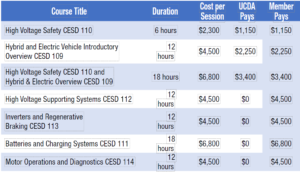
High Voltage Safety CESD 110 (6 hours)

A perfect primer for sales staff and techs who may know very little about this unique form of motor vehicle, this course requires no technical knowledge, takes 6 hours, and costs $2300.

The UCDA will pay 50% of that cost!

Centennial College will issue you a Certificate at the end of this 6 hour course.

Hybrid and Electric Vehicle Introductory Overview CESD 109 (12 hours) Your existing 310S service techs will benefit from this because it offers a more detailed technical overview taking a total time of 12 hours at a cost of $4500.

The UCDA will also offer 50% cost sharing of this option as well!

Centennial College will issue a Certificate at the end of this 12 hour course.

CESD 110 plus Hybrid and Electric Vehicle Introductory Overview CESD 109 (18 hours)

Your existing 310S service techs will benefit from this because it adds on to the basic introduction with some more detailed technical overview taking a total time of 18 hours over 3 days at a cost of $6800.

The UCDA will also offer 50% cost sharing of this option as well!

Centennial College will issue a Certificate at the end of this 18 hour course.

The best part? Centennial will come to you, whether you are in Thunder Bay, Windsor, Ottawa or the GTA! Some distance courses will involve an additional hotel and travel charge.

Intermediate

As you can see below, for those dealerships that really want a full training approach, there are additional options you can consider for your Techs including CESD 112-114.

After taking these courses, Centennial will offer a College Certificate of Completion.

For dealers in the GTA, training on-site at Centennial may be preferred to save tying up a bay, and we would still offer 50% of the cost for the basic options should that be the case.

To register: https://www.ucda.org/centennial/ or call the UCDA 416-231-2600 or 1-800-268-2598 or email education@ucda.org.

Estate Sales

With an increasingly aging population, the sad reality is that more people are passing away. Even funeral homes are seeing the surge in numbers (and yes, Covid is not helping). As a result, dealers are being asked by bereaved families to buy vehicles, once owned by the deceased.

There are pitfalls to this, of course. The first and most important one is ‘who has the legal authority to sell a vehicle to a dealer when the owner has died’.

When a person dies, their assets can be dealt with in any number of ways. If a vehicle was owned jointly, say by a husband and wife, and the husband dies, all the widow has to do is go to a licence office and have the vehicle registered to her name (they will need proof of death like a death certificate).

If the deceased had a Will, then you need to see that and a death certificate. It is best to wait until the Will has been formally ‘probated’ which means a court has approved the Will as genuine and effective. The “Executor” under the Will or “Administrator with a Will” is the person who can sign the contract and legally sell the vehicle to you. Keep a copy of the documents in your file.

If the person died without a Will, then the family will need to obtain a Court Order appointing someone as the “Administrator without a Will” who can act to sell Estate assets, like vehicles, to folks like you. Obviously you will need to see that Court Order. Again, we suggest you keep a copy in your file.

n any case, it is not advisable to make payment to individuals in such a case. Payment should be made to “The Estate of the Deceased”. It is the job of the Executor or Administrator to then take the funds and distribute them to beneficiaries in accordance with the Will or other legal entitlements.

A dealer is not in a position to make those assessments, which is why you should never make payments to individual family members, spouses, children and so on. If you make wrong decisions, you could be faced with angry beneficiaries, or worse, lawsuits.

Powers Of Attorney

Dealers will have received a notice from OMVIC back in August about some changes the Ministry of Public and Business Service Delivery and Procurement and the Ministry of Transportation have made to the use of Powers of Attorney (POA) for vehicle registration.

https://tinyurl.com/2wx7hjch

We are writing to inform you of important updates regarding changes to restrict the use of a Power of Attorney (POA) and a New Vehicle Information Statement (NVIS). Effective September 9, 2024, the following changes will be implemented for motor vehicle registration to enhance the security and integrity of dealer transactions.

Key changes as outlined below:

• Power of Attorney (POA) changes:

  • A POA will no longer be accepted from individuals who request transactions on behalf of an Ontario dealership.
  • Exemptions: individuals registering an out-of-province leased vehicle and individuals buying out a leased vehicle.

These changes are part of a suite of reforms the Ministries have made, and more are planned, to try and address the exploding problem of vehicle fraud and theft affecting our registry systems. The problem is the criminals know the system and how to exploit our processes.

What was a little unfortunate about the notice was it did not make it clear that the changes do not affect dealer transactions. The restrictions outlined in the OMVIC bulletin apply only to individuals requesting transactions on behalf of Ontario dealerships. This should not require any changes to your current business practice.

This confusion resulted in a fairly large number of panicked calls to our office. Dealers often rely on POAs to get deals done where, for example, one dealer is buying a vehicle from another dealer or to finance to a consumer or lease, and the dealers are far apart geographically making registration difficult without the use of POAs.

These are the rules in place since 2011 as to Business Powers of Attorney, forms are available at Service Ontario Licence Offices:

Power of Attorney (POA) Document Checklist for Businesses Effective June 27, 2011

The following elements must be present on the POA document for businesses in order for a corporation to be able to complete a vehicle transaction on behalf of another corporation.

  1. The document must be clearly labelled “POWER OF ATTORNEY”.
  2. The document must include the complete legal name, operating name (if applicable) and full current address of the “grantor” (i.e. leasing company, finance company, auction or dealer).
  3. The document must include the complete legal name, operating name (if applicable), and full current address of the “attorney” (i.e. the company name of the vehicle dealer or auction).
  4. An authorized representative from the “grantor” must sign and date the document. An electronic or photocopied signature of the authorized individual is acceptable.
  5. There must either be a statement accompanying the signature of the grantor’s authorized signing officer that says “I/We have authority to bind the corporation” OR a corporate seal beside or near the signature.
  6. An authorized representative from the “attorney” must sign and date the document. The document must contain the original signature of the authorized individual.
  7. The POA must describe the power being granted. The power may be specific to certain types of activities or it could be general.
  8. Other elements may be necessary depending on the nature of the power granted. For example, where the power is effective for a limited time and/or for certain dates, such times and/or dates must be clearly specified.

NOTE: Auction houses that have an existing POA on file at a ServiceOntario Centre:

  • If the POA on file has an original signature of the grantor, it does not require the original signature of the attorney.
  • If the POA on file does not have an original signature of the grantor, the original signature of the attorney is required.
  • Additionally, where any conditions in the POA change, a new POA is required and must comply with the requirements in the checklist.

We will, of course, continue to work with both Service Ontario and the MTO as these reforms play out. We will keep our members informed, as always.