

This article was kindly provided by Philomena Comerford, the President & CEO of Baird MacGregor Insurance Brokers LP, the broker the UCDA works with on our Garage Insurance program.
Reforms to Ontario’s Automobile Accident Benefits insurance were introduced on July 1, 2026. These reforms change which no-fault accident benefits remain standard, which benefits have become optional, and who has access to the standard versus the newly categorized optional benefits. Under the reform, Medical Rehabilitation and Attendant Care benefits will remain as the only standard statutory accident benefits.
These changes apply to all Ontario Automobile policies, which include Garage Automobile policies.
Objective of Accident Benefit Reform
The primary objective of these reforms is to give more choice over no-fault accident benefits selections and to protect other available benefit programs by making the auto insurance policy respond as the first payor for medical and rehabilitation benefits (excluding medication expenses), in the event of qualifying injuries arising from a motor vehicle accident.
What to expect
As an interim step to this reform’s rollout, during the first year of its introduction which began July 1, 2026, most insurers are offering the expiring policy’s roster of accident benefits coverages and limits meaning that any benefit that has since become optional would continue for the first renewal, along with any benefits previously classified as optional coverages that were purchased under the expiring policy, unless the policyholder elects to discontinue any coverages deemed optional.
However, any new automobile policies issued after July 1st will be subject to the new reforms and careful decisions will need to be made regarding which optional benefits are recommended for the dealer’s circumstances bearing in mind that the basic standard coverage has narrowed considerably. Insurance brokers play an important advisory role in helping policyholders understand their options and in turn, equipping them to make informed choices for their situation.
Optional Benefits Selection
The charts illustrate which categories of benefits (without reference to the limits for each) were considered standard versus optional buy-ups prior to the reforms and how these choices changed on July 1, 2026. Any accident benefit buy-up options that existed prior to these reforms will continue to be available such as Medical, Rehabilitation & Attendant Care optional increased limits and removal of the 5-year time limit, Income Replacement increased weekly limit options, among the other buy-up options listed below.
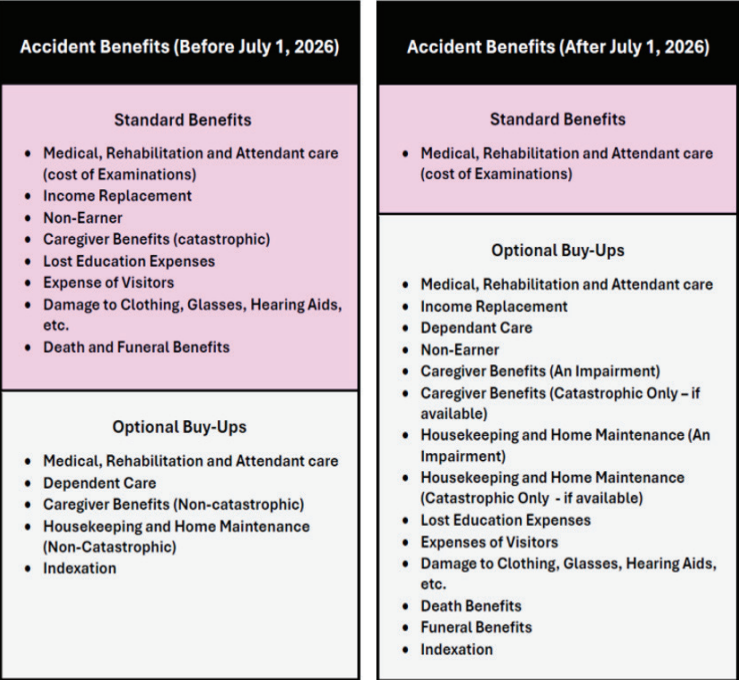
The broker can provide the dealer with information on the limits and scope of each of the standard and optional benefits along with guidance on how these buy-up options fit their situation.
Who has access to basic versus optional benefits?
There is no change to who can access the remaining basic statutory accident benefits of ‘Medical Rehabilitation and Attendant Care.’
However, only the named insured, the spouse of the named insured, the dependents of the named insured and of the named insured’s spouse, and the persons specified in the policy as drivers of the insured automobile(s) have access to the optional benefits. Only family members who are either a spouse or dependent of the named insured are covered under the optional accident benefits but no other family members. Employees only have coverage under the optional accident benefits if they are listed drivers on the Garage Policy.
Importance of keeping listed drivers under your garage policy up to date
Dealers should be very careful to list all existing and any new drivers under their garage policy to ensure access/eligibility for any of the Garage Policy’s optional accident benefits.
If the dealer has provided a dealer owned vehicle to anyone who is not an employee, these individuals should be listed on the policy to be able to access any optional benefits in the event of a motor vehicle accident.
It is also important to remove drivers who are no longer employed or any other listed driver who is not an employee and who no longer drives a dealer vehicle, which will protect the dealer’s garage policy from remote people attempting to claim benefits.
For employees who are not listed drivers but on rare occasion might drive a company owned or customer’s vehicle, these employees will only have access to the basic statutory accident benefits but not any optional benefits the dealer purchased.
Other Considerations
WSIB is intended to cover workplace injuries. Employees of dealers enrolled in WSIB will not be covered under WSIB for injuries sustained while driving a dealer owned automobile for personal use. As such, dropping optional coverages such as the Income Replacement Benefit could have devastating consequences for the dealer employee who is unable to work and cannot turn to WSIB for this benefit if the injury occurred off the clock or where unemployment insurance is limited.
Dealers who have a group benefits plan should check with their benefits advisor about whether their group plan will cover injuries sustained in an automobile accident, its scope and any limitations before considering dropping any no fault accident benefit optional coverages under the Garage Automobile policy.
Dealers should consult with employment counsel about the implications of reducing accident benefit coverages in the context of employment agreements particularly where driving forms part of the job or where the withdrawal of previously afforded benefit(s) could leave the dealer vulnerable to an employment practices lawsuit, or an unintended gap in promised benefits such as short-term or long-term disability coverage.
If a dealer does not wish to list a driver or provide regular use, it is advisable to obtain details of the employee’s personal auto insurance policy that names the employee. This could be the case for underage drivers, on account of a poor driving record or scope of their work.
Occupants of the dealer’s vehicle including customers who are on a test drive, or cyclists or pedestrians who are injured by a dealer vehicle and who do not have access to no-fault accident benefits under their own priority automobile policy, can only access the dealer’s Garage Policy’s basic statutory accident benefits coverage, namely Medical Rehabilitation and Attendant Care but none of the dealer’s optional benefits.
As a result, claimants who had access to the broader range of no-fault accident benefits prior to the July 2026 reform might be more inclined to sue for injuries if the dealer vehicle was at fault or partially at fault for the injuries. Therefore, dealers should consider purchasing higher automobile liability limits to protect the business in the event of a major accident where the claimant is seriously injured such as quadriplegia, paraplegia and damages exceed the Garage Automobile Liability policy limit.
A dealer’s employees might have a limited social safety net to support them following an accident and therefore the dealer should carefully contemplate the implications of no-fault coverage reductions for their employees or anyone who the dealer wishes to provide protection.
Dealers are encouraged to seek advice from their broker to ensure wise choices are made about their options under this reform.