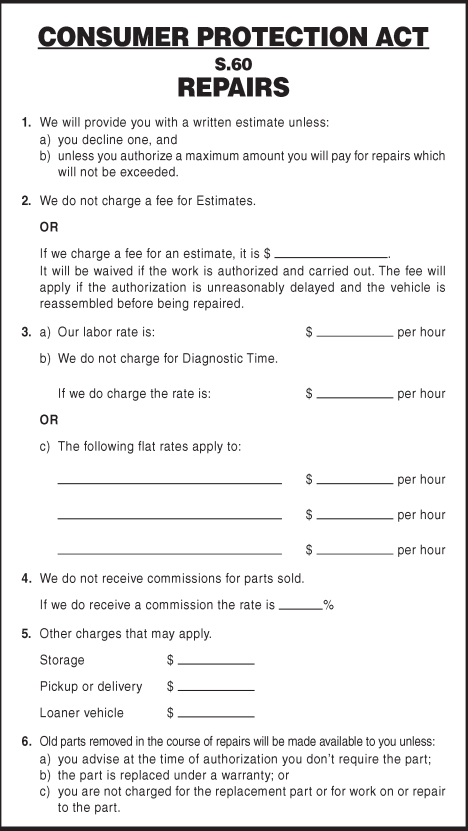

REPAIRS
“In the real world!”
It’s 7:30 a.m. and you arrive at the dealership to unlock the service bay doors, and 3 vehicles are parked outside. Your regular customers know the routine … leave your car on the lot, drop the keys through the slot, and we’ll call you when we open.
Mr. Smith wants an oil change, Mrs. Baker is complaining of a “ping” sound in the rear of her vehicle and Mr. Johnson wants to price the installation of his new CD Player.
The Consumer Protection Act, 2002, whose Regulations came into effect on July 30, 2005, require that consumers be given a written estimate for repairs unless they decline that and authorize a specific amount that they will pay instead.
But how does this work in the real world, where vehicles are left for service overnight?
Even if your customer is not there at the counter, you can still communicate in writing using fax, e-mail, text or through electronic signing services such as DocuSign. Having a signed document is always the strongest defence and is necessary when you may need to claim a, non-possessory, Repair and Storage Liens Act (RSLA) lien.
Where this is not practical, the answer is to keep excellent paperwork. Your intake form, whatever design it has, must include a portion for telephone authorization, which should include:
- Whether the customer wants a written estimate and, if not, what price the customer will agree to pay for the repair
- When a diagnostic is required, the charge and how it is calculated;
- The name of the person giving the authorization;
- The date and time of the authorization;
- The phone number of the person giving the authorization.
Clearly, in this example, Mr. Johnson wants a written estimate (and you can charge for that as long as you disclose the charge up front). If you go ahead with the install, any such fee would be waived.
Mr. Smith may very well opt not to have a written estimate for an oil change and could easily give authorization over the phone to proceed with that repair for a set price
Finally, Mrs. Baker cannot have a written estimate (or opt to pay an agreed price) before you know what’s wrong! Her “ping” complaint would need to first be diagnosed and again, you discloses the rate you charge for the time it takes to diagnose a problem. Once diagnosed, authorization could be done over the phone, by fax, e-mail or in person as with any other customer.
These rules are all set out on the sign you have posted (or should have posted) on your wall.
REPAIR SIGNS
The Consumer Protection Act requires that repair facilities offer written estimates on all repairs (unless the customer declines and instead authorizes a maximum repair amount).
If the repairer charges a fee for the estimate, and the actual repair is later authorized to proceed, the estimate fee must be waived.
Repairers, and dealers with service facilities, need to remember that if a vehicle comes in with a problem that will likely take significant time to diagnose before repairs can even proceed, you are better advised to bill separately for diagnostic time, rather than charge a fee for an estimate.
Consult your UCDA Repair Sign, which explains how all this works to your customers.
If you don’t have a Repair Sign visible to the public, as the law requires, please contact the UCDA at 416-231-2600 or 1-800-268-2598 for more information about getting one.