
UCDA FEE REDUCTIONS

For its members, the UCDA is many things. We are an advocate for dealers. We are an educator. We are a trusted advisor. We are a friend. We are also a not-for-profit trade association. This last thing means that we have the flexibility to strive to find value for our members. While we have to be able to pay our staff, keep the lights on and coffee in the pot, we are not profit driven.

Through our programs, our fees, and the excellent work our people and our Board of Directors do, to make this all work as well as it does, we boast an enviable member retention rate. This enables us to return value to members, and not for the first time.

In the last couple of years, members have seen the UCDA deliver free 40 year anniversary swag, subsidized EV training, Key Elements rewrite cost underwriting, fee reductions in 2024 for vehicle lien and history searches, as well as Power Pack savings for 20 year + members. As if this was not enough, we also make all of our best-in-class sales and lease forms available for electronic use by members free of charge!

Should we even mention that we have not increased UCDA membership fees in years, made significant improvements to our health and dental insurance plan, and ensured our partnerships are delivering value for money to our members?

Too late, we just did!

So, we figured, why not see if we can’t do it again?

FEE REDUCTIONS Coming May 1, 2026

AUTO CHECK

We charge $8 for Auto Check™. A comprehensive search for vehicle insurance claims is of great importance to dealers, and it is an alternative to other more costly accident searches in the market. It’s not a one-size fits all solution, but in the right cases it can be an excellent way to help appraise a vehicle affordably, or supplement other accident searches dealers have run.

We plan to reduce the fee for Auto Check by $2, so as of May 1st it will cost a member $6 to run an Auto Check™.

LIEN SEARCHES

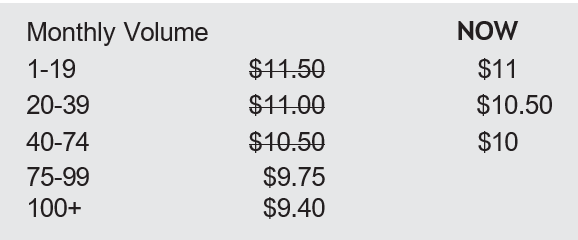
First Tier Lien Searches were reduced to $11.50 in 2024, making them the most affordable lien search offered in Ontario.

We are lowering several tiers this year. Most members using lien search fall into these top tiers.

As of May 1st, a UCDA lien search will cost only $11 in the first tier!

Further volume discount adjustments have also been made as follows:
VEHICLE HISTORY SEARCHES

In 2024 we lowered the cost of UCDA Vehicle History Searches from

$16 to $15. Members responded by running these searches in increasing volumes. We have taken account of this and now wish to give savings back, once again.

Effective May 1st, Vehicle History Searches will reduce in cost from $15 to $13!

POWER PACK

As mentioned, in 2024, for members with 20 years or more continuous membership in the UCDA, we offered a discount of $4 on Power Pack, reducing that cost from $29 to $25.

We are now extending this offer, as of May 1st, to all members!

Power Pack will now cost all UCDA Members just $25!

FILLABLE WHOLESALE VEHICLE BILL OF SALE

We promised you an online fillable Wholesale Vehicle Bill of Sale in 2026, well here it is! Designed to make your transactions smoother and more efficient, this easy-to-use, fillable document is perfect for handling your wholesale needs and …

It only costs $2.49 per bill of sale! Exceptional value! Available to all UCDA members using your dealer number.

No more hand-writing, savable, use your logo, dealership name and address, sub-totals and taxes calculated automatically.

Powered by Surefire SolutionsSureFireSolutions.com Inc. Visit: https://www.ucda.org/easybos/ to get started today!

Our Promise To You

The UCDA will continue to strive to deliver value to members in every way we can.
 

Anatomy of a Curbsider

People often ask, what is a curbsider?

If you love cars so much you own ten, you are not a curbsider when you go to sell them. Why? Because you bought them to own them, enjoy them, drive them from time to time, insure them and generally act like they were yours.

Curbsiders don’t do that, they buy and sell for the sole purpose of turning a profit. They behave like dealers except they avoid the hassle of actually registering with OMVIC, leaving consumers who buy from them vulnerable to poor disclosures, liens, bad odometers, no access to the Compensation Fund or recourse to mediation with UCDA or OMVIC.

This case illustrates perfectly what this looks like in practice:

Edited for space

See full case here: https://tinyurl.com/4uuf4kna

ONTARIO MOTOR VEHICLE INDUSTRY COUNCIL

— AND —

CHRISTIAN NICHOLAS IRVEN JOVER

  • The accused pleaded not guilty to six offences under the Motor Vehicle Dealers Act, … and the Consumer Protection Act …
  • Specifically, he is charged that he acted as a motor vehicle dealer when not registered to do so in relation to four vehicles and that he engaged in an unfair practice by making false, misleading or deceptive representations regarding the trade of two
  • … In total there are four vehicles at issue:
    • A 2006 Acura CSX

    Alleged that between November 7, 2024 and November 13, 2024 he acted as a motor vehicle dealer …

    • A 2006 BMW X3

    Alleged that between October 26, 2024 and January 27, 2025 that he acted as a motor vehicle dealer …

    • A 2011 Acura CSX

    Alleged that between January 10, 2025 and February 24, 2025 that he acted as a motor vehicle dealer …

    • A 2016 Kia Sorento

    Alleged that between March 14, 2025 and April 16, 2025 that he acted as a motor vehicle dealer …

  • There is little dispute as to the facts … His position is that all of the sales should fall within the following exemption set out in Section 5 of the Motor Vehicle Dealers Act:

    An individual who trades in a motor vehicle on his or her own account or on the account of a member of the individual’s family is exempt from the registration requirements under section 4, if the motor vehicle is used primarily for the personal use of the individual or a member of his or her family.

    EVIDENCE RELATING TO THE 2006 ACURA CSX
  • Mike Bennett … saw an advertisement for a 2006 Acura CSX that had been placed by Jover and reached out to him … Mr. Bennett viewed the car in the driveway at the accused’s residence in Barrie, took it for a short test drive, and they agreed upon a price of $4300 …
    • Jover suggested to Mr. Bennett that he under-report the price of the vehicle when registering it in order to pay tax on a lower amount. He provided a bill of sale that reflected a sale price of
  • $1000 …

  • At the time of registration, Mr. Bennett became aware that Mr. Jover had not owned the vehicle as long has he had earlier claimed. He sent the following text message to the accused: “The vehicle history report says you registered this car on Nov 7th 2024. I thought you said you bought this car last year and have been driving it around?” The accused responded “It was in my wife’s familys name before I registered it I think it was registered under her We have been driving it for about a year but only switched over the ownership recently after he past away.” …
  • At trial, Jover admitted that he had lied to Mr. Bennett, that he had actually purchased the vehicle on November 7, 2024, …
  • About two weeks after the purchase, Bennett … discovered substantial frame damage … He contacted Mr. Jover and asked to undo the transaction … Mr. Jover refused, advising that the car had been sold “as is,” that he is not a dealer, that the Consumer Protection Act does not apply to private sales, and that he therefore does not owe anything to Mr. Bennett

EVIDENCE RELATING TO THE 2006 BMW X3

  • Scott Virtue is the manager of Complaints, Inquiries and Compliance for … He responded to an advertisement for a 2006 BMW X3, listed by Mr. Jover on Kijiji for $3300. He viewed an advertisement on January 6, 2025, noting that it had been placed on December 24th and that it stated “Over 4k invoices since 2022, well maintained, always kept up with service.”
  • Virtue attended at Mr. Jover’s residence on January 8, 2025. Mr. Jover told him that he had owned the vehicle since September and provided invoices for work that had been performed on it. The invoices showed the owner of the vehicle at the time was a numbered company … records show that the accused had purchased the vehicle on October 26, 2024.
  • Jover ultimately sold the BMW to a member of the public who called him with issues shortly after the sale … He maintains that his advertisement was not misleading as he did not explicitly say that he was the owner who had spent over $4000 on repairs

    and maintenance since 2022. Further, he maintains that he had no obligation to disclose known deficiencies of the vehicle to the buyer as he is not a registered dealer.

EVIDENCE RELATING TO THE 2011 ACURA CSX
  • Marc Duvall is the Manager of Investigations for OMVIC. He reached out to the accused as an undercover buyer regarding a 2011 Acura CSX that the accused had listed on Facebook Marketplace for $4800. Duvall set up a meeting and attended at the accused’s address in Barrie on January 19, 2025. Mr. Jover advised him that he had purchased the car as a “winter beater,”… He said he had owned it “not long” and “less than a year.” In fact, according to MTO records, the vehicle had been registered in his name only two days prior.
  • At trial, the accused testified that he had purchased the vehicle on January 7, 2025. He testified that he was trying to sell it as he had two summer cars that he brings out and that he ultimately sold the car to a member of the public on March 15, 2025.
EVIDENCE RELATING TO THE 2016 KIA SORENTO
  • Jover purchased the 2016 Kia Sorento from his employer, Georgian BMW Mini, where he works as a lot attendant. The vehicle had come into the dealership as a trade-in, and Mr. Jover paid $6500 for it on March 14, 2025, registering it under his own name on the same date.
  • He testified at trial that right after buying the vehicle he realized that there was no oil in it and suspected that it was traded in because it was burning through He did an engine flush but it still burned through a litre of oil per 1000 kilometers and it was more than he could keep up with …
    • He listed it for sale on Facebook Marketplace on April 1, 2025 for

    $10,500. The advertisement included the following statements: “No warning light or mechanical issue – had the car serviced recently – insured and I drive it to work everyday – serviced with synthetic oil every 5k – only issue I am having with the vehicle is the rearview camera is not getting a picture, and there was a minor Carfax claim in 2015 for front right. Also the passenger front door has some rust.”

  • Scott Virtue of OMVIC reached out to Jover as an undercover buyer. He expressed interest in the vehicle and subsequently attended at Mr. Jover’s address on April 16, 2025, taking photos of the vehicle during the short meeting …

ANALYSIS

  • Jover admits that he advertised and/or sold vehicles during the relevant dates, and to the communications attributed to him. He argues that the exemption at s.5 of the Motor Vehicle Dealers Act does not specify a minimum length of time that a private seller must own a vehicle prior to listing it for sale, and that each of his trades should therefore fall within the exemption …
  • Jover testified that he had taken the OMVIC course and was aware of the disclosure obligations … When he was asked during cross-examination … whether he understands that registered dealers have an obligation to disclose such problems, he responded glibly “but I’m not a registered dealer.”
  • Mr. Jover appears to presume that by characterizing his trades as private sales that he was exempting himself from the requirement to make the honest disclosure …
  • Jover’s representation to Mr. Bennett, that he and his wife had been driving the 2006 Acura CSX for the past year, was … false and deceptive …
  • … whether the vehicles were used primarily for Mr. Jover’s personal use and therefore fall within the exemption is a question of actual use as opposed to intention. Mr. Jover asserts that he changed his mind about each of the vehicles after purchasing them and that the exemption does not specify a minimum length of time that one must own a vehicle …
  • Jover’s account … lacks credibility, especially when considered as a whole. The circumstances surrounding the trades of the four vehicles clearly demonstrate a pattern of trading in vehicles for profit as opposed to legitimate personal use …
  • That Jover registered the vehicles in his own name, that he insured them, and that he met with buyers at his home address are not determinative of the issue …
CONCLUSION
  • I am satisfied beyond a reasonable doubt that Jover acted as a motor vehicle dealer regarding the trade of the four vehicles when not registered to do so, and that he made a false, misleading and deceptive statement regarding the 2006 Acura CSX. I therefore find him guilty on counts 1, 2, 3, 5, and 6 on the Information. I have been invited to acquit on count 4 and I do so.

Released: January 28, 2026

Signed: Justice of the Peace C. Noordegraaf


ELECTRIFYING NEWS

For a nation that seems slow to take an interest in electric vehicles, we sure seem to be talking about them a lot lately.

The Feds have just announced a new subsidy for electric vehicles;

$5,000 for a new EV, and $2,500 for a new plug-in hybrid as of Feb. 16th. This is only for vehicles sold or leased for under $50,000, unless the vehicle is made in Canada. The subsidy will become less generous and reduce over time.

Nothing for used cars, and no the subsidy will not apply to those Chinese EVs we may be seeing soon, it’s only for imports from countries with whom we have pre-existing free trade deals e.g. the U.S. and Mexico for example. Speaking of Chinese EVs …

China is Coming!

Prime Minister Mark Carney went to China recently and, with tariffs and trade winds at his back, came back with a deal.

China gives us a break on some of our agricultural products, and we will allow some of China’s cheaper electric vehicles into our market. Here is a summary to try to help make sense of what this means for our market:

Canada will sharply reduce tariffs on electric vehicles imported from China. Tariffs are cut from 100% down to about 6.1% for Chinese-made EVs entering Canada.

Canada will implement an annual quota of 49,000 EVs per year initially. That quota is expected to increase gradually to roughly 70,000 vehicles by the fifth year of the agreement.

At least 50% of these vehicles must be “affordable” models priced below about C$35,000 by 2030.

Which Brands Are We Talking About?
  1. Any Chinese-built EV can technically be eligible

    The tariff deal doesn’t explicitly name specific brands. It lowers tariffs on EVs “made in China” and allows up to about 49,000 Chinese-built EVs to be imported per year.

  2. In practice, only vehicles with Canadian/North American certification and approvals can sell right away

    To actually be sold and registered in Canada, EV brands must meet Canadian safety, emissions, and other standards (crash testing, lighting, climate control, etc.). So:

    Tesla (Shanghai-built Model 3/Model Y) is expected to be an early beneficiary because it already meets standards and has an established dealer/network footprint in Canada.

    Geely controlled brands like Volvo and Polestar — some of whose China-built EVs already meet North American regulatory requirements — are also likely to be early importers.

    BYD electric vehicles are cleared to enter the Canadian market, for models that comply with Canadian Motor Vehicle Safety Standards.

  3. Other Chinese brands

    Many major Chinese EVs are eligible in principle under the tariff change and represent major players globally.

However, many of these have not yet completed Transport Canada certification or established Canadian sales/service networks, so they won’t appear in large numbers right away.

Finally, of note, this deal does not include used Chinese EVs.

If this lower priced product eventually makes it into the used market you may find more consumers interested in buying.

Dealers should be ready to learn more about EVs

UCDA and Centennial Partnership

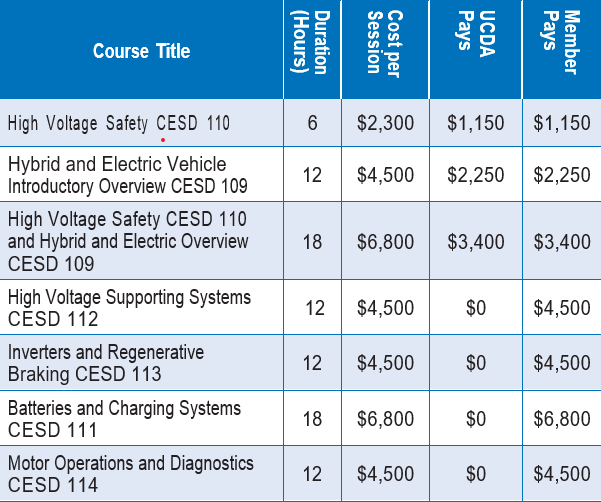
Since 2024, the UCDA has partnered with Centennial College to deliver Electric and Hybrid (EV) vehicle training to your staff and is offering 50% off the cost of the basic programs!

Whether it is basic knowledge your team seeks, perhaps to familiarize your sales staff with the EV product at its most basic level, or a higher-level dive in for your existing 310S service technicians, at an intermediate level, Centennial and the UCDA are working together to deliver it to you.

Offered to class sizes no larger than 12, Centennial will come to you, take over a bay for a few hours, and teach the program offerings described below:

Basic

High Voltage Safety CESD 110 (6 hours)

A perfect primer for sales staff and techs who may know very little about this unique form of motor vehicle, this course requires no technical knowledge, takes 6 hours, and costs $2,300.

The UCDA will pay 50% of that cost!

Centennial College will issue you a Certificate at the end of this 6 hour course.

Hybrid and Electric Vehicle Introductory Overview CESD 109 (12 hours)

Your existing 310S service techs will benefit from this because it offers more detailed technical overview taking a total time of 12 hours at a cost of $4500.

The UCDA will also offer 50% cost sharing of this option as well!

Centennial College will issue a Certificate at the end of this 12 hour course.

CESD 110 plus Hybrid and Electric Vehicle Introductory Overview CESD 109 (18 hours)

Your existing 310S service techs will benefit from this because it adds on to the basic introduction with some more detailed technical overview taking a total time of 18 hours over 3 days at a cost of $6800.

The UCDA will also offer 50% cost sharing of this option as well!

Centennial College will issue a Certificate at the end of this 18 hour course.

The best part? Centennial will come to you, whether you are in Thunder Bay, Windsor, Ottawa or the GTA! Some distance courses will involve an additional hotel and travel charge.

Intermediate

As you can see below, for those dealerships that really want a full training approach, there are additional options you can consider for your Techs including CESD 112-114.

After taking these courses, Centennial will offer a College Certificate of Completion.

For dealers in the GTA, training on-site at Centennial may be preferred to save tying up a bay, and we would still offer 50% of the cost for the basic options should that be the case.

To register: https://www.ucda.org/centennial/

or call the UCDA 416-231-2600 or 1-800-268-2598

or email education@ucda.org

JOB ADS

As of January 1, 2026, employers with 25 or more employees should be aware of new requirements in Ontario for public job ads.

  • Employers must include either a specific salary or wage, or a payment range (above or below) within $50,000 per This requirement does not apply if the expected compensation is equivalent to more than $200,000 per year, or the range of the expected compensation ends at an amount equivalent to more than $200,000 per year
  • Employers will no longer be permitted to include a requirement for “Canadian experience”. This restriction does not prevent employers from confirming whether a candidate is eligible to work in Canada, it simply prohibits using “Canadian experience” as a screening shortcut
  • Job postings must now clarify whether the advertised position reflects a current vacancy or a prospective opportunity
  • If an employer uses artificial intelligence to screen, assess, or select candidates, that fact must be stated directly in the job posting
  • Employers who interview applicants will be required to notify each of the outcome, or where the process stands, within 45 This can be done in person, in writing, or electronically
Record-Keeping Requirements

Employers must keep copies of:

  • all publicly advertised job postings
  • any application forms used
  • information shared with interviewed candidates, for a period of three years after the posting is

KPMG and FINTRAC

In an ongoing effort to help UCDA members meet the challenges of Anti-Money Laundering (AML) regulatory requirements, and stay on the right side of the Financial Transactions and Reports Analysis Centre of Canada (FINTRAC) regulator, we are pleased to announce an upcoming webinar offered by KPMG specifically for motor vehicle dealers.

Training Session:

Navigating AML Compliance for Automotive Dealers

Our upcoming training session, scheduled for February 24th 2026 from 10am to 11am EST, hosted by KPMG will provide an overview of the obligations of automobile dealers, as it relates to the establishment of AML Programs required by FINTRAC by April 1st, 2026, and what this may look like in practice.

REGISTER HERE

https://tinyurl.com/nh8z68sj

KPMG will provide an overview of regulatory expectations and industry best practices for client identification and “KNOW YOUR CLIENT” requirements, ongoing monitoring, reporting obligations, record keeping expectations, and how to spot red flags related to fraud and suspicious transactions.

The training session will also provide time to review practical examples from hypothetical dealership scenarios and provide guidance on how to build an efficient, properly fitted AML compliance program using some of the processes and tools you already have in place.

If you are involved in the leasing or financing of motor vehicles in any way, you won’t want to miss this important information session.

National Bank Bonus!

In celebration of Winter and the UCDA / National Bank partnership, a special $125 bonus is in place now until, at least, the end of February for each funded contract!

UCDA members that fund deals with National Bank enjoy an extra 10% when compared to National Bank’s standard offers.

In addition, from April 17, 2025, and until further notice:

  • Quality bonus up to $1,200 (limited time) for financing amounts starting at $20,000 or more! No cap on reserves!
  • Earn more with our Quality Bonuses* Limited time Quality Bonus $7,500 to $12,499 $12,500 to $19,999 $20,000 or more Up to $500 $625 $1200

    * Bonus subject to change upon resubmission.

  • Competitive Rates**:

    … Fixed Rates starting at 6.99% with reserves up to 3.25%

    … Variable Rates starting at 6.70% with reserves up to 2.70%

  • Maximum Amortization: 96 months  **Terms and conditions apply.

In 2025, our relationship with National Bank delivered, to participating members, special bonuses amounting to 4 million dollars in extra reserves!

The partnership between the UCDA and National Bank presents a unique opportunity for UCDA members to capitalize on increased reserves and attractive bonuses while offering competitive financing options to customers.

Interested?

To register, you can speak with your UCDA Member Services Advisor by calling the UCDA 1-800-268-2598 or email: memberservices@ucda.org

You can also contact your local National Bank representative.

UCDA Continuing Education

Now Offering – OMVIC Certification Course Primer

A workshop for new applicants, to help prepare you to succeed when you take the OMVIC Certification Course required to become a dealer or salesperson in Ontario.

$49.99

Coming in April 2026 – OMVIC CPD Primer

A seminar to review and prepare you to succeed with the OMVIC Continuing Professional Development courses for dealers (every year) and salespeople (every two years). It’s designed as an informal session that can be conducted via Zoom or in person offsite or at your dealership for groups. We can focus on topics that are important to you, such as the application of laws, financial responsibility, ethics, and professionalism.

FREE* to UCDA Members (or their salespeople)

Now Offering – Key Elements Primer

A seminar designed to help grandfathered registrants or anyone else required to take the Key Elements Course offered at Georgian College.

FREE* to UCDA Members (or their salespeople)

All these options can be offered virtually and, where numbers warrant, in-person.

* You still have to pay OMVIC $99.00 for CPD and Key Elements costs $202.86.

Fast Start Sales Training

This is a one-day introductory workshop, launched in 2014, designed for new salespeople and taught by Wye Management. It covers every stage of the sales process—from understanding dealership operations and qualifying customers to handling objections, appraising trade-ins, and closing deals—providing participants with practical, modern techniques for successful automotive sales.

Cost $245+HST members

$325+HST for non-members. 

If you are interested in any of our educational offerings contact education@ucda.org or call the office at 416-231-2600 or 1-800-268-2598 and ask for Val or Sukh. Please visit our website for more information on all of this:

https://www.ucda.org/education/ucda-continuing-education/

More Exporter Scrutiny

It seems the Feds are taking an ever-growing interest in the export side of the used car business in Canada. This may be because of calls from organizations like Carfax, Équité and the UCDA for more data sharing on Export VINs by the CBSA, but this shocking story out of London Ontario has captured the interest of quite a few folks who follow developments on this front.

CBSA serves $36.9M penalty to Ontario business owner for failing to declare exported vehicles

News release December 8, 2025

The Canada Border Services Agency (CBSA) is detecting and disrupting illegal trans-border activities that threaten Canada’s economic prosperity.

An Ontario business owner has been served a $36.9 million penalty for failing to declare over 2,300 used vehicles exported from Canada, following an investigation led by the CBSA.

The CBSA’s Criminal Investigations Section in Halifax initiated the investigation in 2021 to further examine an Ontario exporter who was believed to be shipping a large number of used vehicles from Canada to West Africa without completing any of the required export declarations. Two search warrants executed by the CBSA in London in July 2023 resulted in the seizure of various items including business

and financial records, vehicle titles, bills of sales, bankers boxes of documents, computers, cell phones, and SIM cards.

In August 2025, after reviewing and analyzing more than 750,000 records collected throughout the course of the investigation, the CBSA served a Notice of Ascertained Forfeiture to the business owner for not reporting the exported goods as prescribed under section 95 of the Customs Act. The business owner is required to pay CAN$36.9 million—the amount equivalent to the full value of the exported vehicles.

The CBSA thanks the Financial Transactions and Reports Analysis Centre of Canada (FINTRAC) for their dedicated work and collaboration during this investigation. The CBSA also recognizes the US Customs and Border Protection, Homeland Security Investigations, Public Prosecution Service of Canada, Forensic Accounting Management Group, and the London Police Service for their assistance.

Anyone with information on suspicious cross-border activity is encouraged to call the toll-free Border Watch Line at 1-888-502-9060 or fill out the secure online reporting form.

Quotes

“The Canada Border Services Agency is dedicated to keeping Canadians safe. It also plays a crucial role in protecting the integrity of Canada’s financial and trade systems. The agency’s work to investigate suspicious cross-border transactions helps to secure our country and contribute to Canada’s economic prosperity.”

– The Honourable Gary Anandasangaree, Minister of Public Safety 

“The work accomplished by CBSA investigators and intelligence analysts plays a big part in protecting the border, our communities, and the Canadian economy. The multi-million dollar penalty attached to the outcome of this investigation sends a strong reminder to commercial exporters that they will be held accountable for not respecting mandatory reporting requirements and Canadian laws.”

– Dominic Mallette, Regional Director General, Canada Border Services Agency, Atlantic Region

Quick Facts

Ascertained forfeiture is the legal process used to issue a monetary penalty when the seizure of the goods is impractical or impossible, as is the case when they have already been exported from Canada, or disposed of in Canada. A Notice of Ascertained Forfeiture is served to the individual, demanding payment of an amount equal to, or lesser than, the value of the goods, pursuant to section 124 of the Customs Act.

The CBSA works closely with domestic and international law enforcement partners, intelligence agencies and the financial services sector, to investigate a wide range of suspected Customs Act offences and contraventions, including those related to the import and export of goods.

The Exporters’ guide to reporting outlines reporting obligations according to Canadian laws. Exporters who do not meet the mandatory reporting requirements may face significant monetary penalties or have their goods detained or seized.

See the CBSA News Release here: https://tinyurl.com/53uv5kr3

A Demo is a Used Vehicle

Demonstrator vehicles hold a special place in the car sales world. Like new vehicles, they are often eligible for manufacturer’s incentives and programs. However, legally, they are still used vehicles.

This is because once a vehicle has been registered to an owner, it is a used vehicle, even if that owner is the dealership. Demos are registered to the dealership so that customers and even employees can take them on trips to “demonstrate” them. Many are often white plated by the dealer. Regardless of the actual mileage of the vehicle, they are used vehicles.

This has important implications for how your dealership advertises and sells these vehicles. Since they are used vehicles, they must be advertised as such. Dealers are expected to use actual photos of the vehicle in advertisements, include the actual history of the vehicle, the status of the vehicle, the odometer reading, as well as information on when the warranty for the vehicle began and the remaining warranty coverage.

Also, keep in mind that because a demonstrator is a used vehicle, when advertising, comparisons to MSRP are not allowed, nor are charges for freight, air and gas tax.

This also means that when registering a new “subject vehicle” above the $100,000 threshold (and which meets all other requirements) to use as a demo, the dealer is responsible for paying the luxury tax for that vehicle. The dealer would not charge the customer luxury tax on a demo vehicle because the dealer is expected to have already paid it and the customer is now buying a used vehicle. The Government of Canada’s website makes this very clear:

https://tinyurl.com/4p8a6uc3

A dealership that is a registered vendor of subject vehicles registers with the Ontario Ministry of Transportation a subject vehicle in its inventory valued above $100,000 in order to use the subject vehicle as a demo vehicle.

The luxury tax is payable by the dealership at the particular time that the subject vehicle is registered with the Government of Ontario.

Demo vehicles are also treated uniquely under the Highway Traffic Act. Regulation 628 of the Highway Traffic Act also provides an exemption on the requirement for a safety standards certificate for demo vehicles that have been operated for 6,000 kilometers or less:

R.R.O. 1990, Reg. 628 VEHICLE PERMITS | ontario.ca

  1. (1) Number plates shall not be approved for use on a motor vehicle and evidence of validation shall not be issued for a number plate unless the motor vehicle’s permit indicates a fit status.
  2. Reg. 172/22, s. 2 (4).
    • A permit indicating a fit status shall not be issued for a used motor vehicle unless a safety standards certificate was issued upon an inspection of the vehicle that was completed within the preceding 36 days. O. Reg. 172/22, s. 2 (4). 
  • Subsection (2) does not apply,

(d) to an application for a permit for a motor vehicle that has been operated 6,000 kilometres or less and for which a permit has been issued under section 7 of the Act in the name of a motor vehicle dealer described in clause (b) or

(c) and has not been in the name of a person other than such a dealer;


Since demo vehicles are used vehicles, it is recommended that dealers perform a thorough inspection of the vehicle before it is sold to a customer. While the vehicle is more than likely to be in tiptop shape, the inspection is important so that the dealer can make any required disclosures to the customer. If the dealer fails to perform a thorough inspection of the vehicle and issues arise, this could spell trouble with both MTO and OMVIC.

Members with questions on how to advertise or sell a demo vehicle can contact the UCDA’s Legal Department at (416) 231-2600 or 1-800-268-2598.

January Is Crime Stoppers Month

January marks Crime Stoppers Month, a time to highlight the vital role Crime Stoppers programs play in helping law enforcement prevent and solve crime across Canada. Crime Stoppers’ ongoing national slogan, “Say It Here,” underscores the importance of providing anonymous tip information that can assist police in identifying perpetrators of crime.

The Canadian Anti-Fraud Centre (CAFC) is joining partners across the country to emphasize how crucial tip reporting is in the fight against fraud. Fraud networks are often sophisticated and far-reaching. While some operate internationally, many criminal groups have strong ties within Canada, recruiting local facilitators and using Canadian infrastructure such as phone numbers, bank accounts, and addresses to carry out their schemes.

The Importance of Whistleblowing

Anonymous tips play an essential role in fraud prevention and enforcement. They help police and the CAFC to:

  • Identify local enablers and facilitators connected to larger fraud networks
  • Trace financial movement, including money mule activity and cryptocurrency pathways
  • Identify criminal infrastructure such as fraudulent phone numbers, emails, domains, and social media ads
  • Connect cases that might otherwise appear unrelated
  • Build stronger investigative files and prepare enforcement action
  • Take disruption measures to interrupt fraud operations operating in Canada

Where and How to Report Fraud

Crime Stoppers – Anonymous Information Sharing

Crime Stoppers programs across Canada allow individuals to report tip information completely anonymously through their online portals, phone lines, or P3 Tips app. Their ongoing national slogan and logo, “Say It Here,” reinforce that Crime Stoppers is a trusted place to

provide information safely and without being identified.

Canadian Anti-Fraud Centre (CAFC) Reporting Fraud Incidents Victims and witnesses of fraud should also report directly to the CAFC through:

Fraud is not a victimless crime. It funds organized criminal groups, targets vulnerable individuals, damages businesses, and results in billions of dollars in losses each year. But fraud can be stopped when Canadians report suspicious activity, share information, and speak up.

The UCDA is proud to continue its partnership with the Ontario Association of Crime Stoppers, an association of 37 local Crime Stoppers programs across the province of Ontario. Our relationship has led to meaningful engagement in Hamilton, Peel and North Bay and, we expect, more communities to follow.

The UCDA works with Crime Stoppers to spread the message ‘if you see it, report it’ via Crime Stoppers’ anonymous tipster program.

The UCDA particularly supports the fight against auto theft and fraud, offering rewards up to $300, for tips that directly lead to the successful recovery of vehicles stolen from dealerships in Ontario.

Famously, Crime Stoppers provides a venue for concerned citizens to anonymously provide information to law enforcement agencies through Crime Stoppers’ 1-800-222-TIPS (8477) line or through a web-based application:

https://ontariocrimestoppers.ca/tip-submission-check

Each local board relies on sponsorship, donations and fundraising to garner the funds to pay rewards and operate their programs.

Crime Stoppers are continuously looking for both financial support and volunteers eager to make a difference in their communities.

These partnerships allow us to contribute to the important work being done toward safety in our communities.